Belshezan’s Beast Summoning
When the Cold Breathes A Ragnar Stormbringer Tale A Ragnar Stormbringer TaleBelshezan’s Beast Summoning is the turning point at which the threatened settlement gains an answering force from the forest. In a marked clearing, Belshezan transforms into a massive bear and sends out a roar unlike any natural animal’s; howls and roars answer across the woods, and predators converge on the Wights surrounding Jarl Thryggvi’s Hill-Fort. Their alliance is as consequential as their numbers: creatures that might ordinarily be enemies fight together against the dead.
Background and Stakes
The summons comes amid two linked dangers. Earlier, Ragnar found the remains of Heimval, a settler killed by a Mayak, and resolved both to avenge him and to aid the people who had sheltered him through the northern winter. Later, the Wights released from the barrows threatened the settlement at the hill-fort. Ragnar and Cnut identify the approaching dead as Wights, reasoning from their uncanny eyes and their emergence from the barrows. The creatures’ assault makes the need for help immediate: the settlement is surrounded, and ordinary defenses face an enemy that does not behave like a living raiding party.
Ragnar reaches Belshezan while carrying a Wight-bite wound. He has been suffering dizziness and increased body heat, and the wound throbs. Belshezan tells him there is no time to rest and leads him from the cave toward a nearby clearing. This urgency links Ragnar’s personal peril to the wider crisis. He needs the sorcerer’s aid, but the summons will also answer a threat to the besieged community.
The Marked Clearing and Transformation
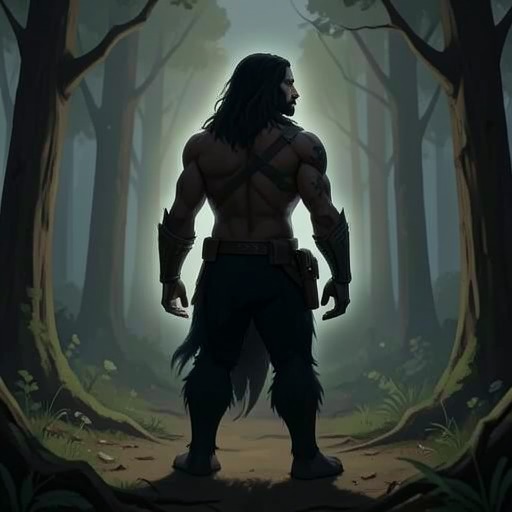
The clearing is prepared with objects of bone and wood hanging from surrounding branches. Symbols carved into the tree trunks face inward, enclosing the space as a distinct ritual setting. Belshezan asks Ragnar to remain at its perimeter and not fear what he sees, explaining that he must take another form before he can summon the needed aid. Ragnar obeys, though his injury leaves him dizzy and the presence of sorcery unsettles him.
Belshezan walks to the center, raises his arms, looks skyward, and speaks a few words in an unfamiliar language. He then closes his eyes and appears to enter a trance before lowering himself to the ground and waiting in silence. The scene’s strangeness builds through physical effects rather than explanation: the air distorts in waves, Ragnar’s skin tingles, and a gathering energy seems to surround him. Belshezan begins to twist and convulse. His skin pulses and contorts amid cracking sounds, while the furs he wears seem to merge with his body.
The change is unmistakably bodily. Belshezan’s nose and jaws push outward into a broad snout; his frame grows in bulk and height; rounded ears rise from his head; and his limbs thicken as his hands and feet become huge paws. When the transformation ends, a brown bear stands in the clearing, larger than any bear Ragnar has seen in his homeland. Ragnar recognizes in its eyes the same quality he had seen in the sorcerer who took the form of the Mayak. The beast is immense, but Ragnar understands that the person before him remains Belshezan.
The Call and Its Answer
The bear rears onto its hind legs, towering above Ragnar, angles its head toward the sky, and roars. The sound does not quickly fade; it deepens and continues, unlike any roar made by a natural bear. Once Belshezan falls silent and returns to all fours, he waits. The response comes from far away: a group of howls rises in the night, followed from another direction by a second chorus. A staggered succession of roars follows, some bear-like and others unfamiliar to Ragnar. More calls sound throughout the woodlands, including from a great distance.
The event does not make Ragnar an informed observer. Captivated, he can only wonder what the calls mean. Belshezan, by contrast, acts as though the answer is understood. He gives Ragnar a low growl, walks toward the far side of the clearing, and looks back with another growl. Ragnar follows, keeping some distance from the bear but managing to keep pace. At this point, the summons is both a distant sound and a direction of travel: Belshezan leads Ragnar toward the force gathering in response.
The change in Belshezan’s form coincides with a rapid improvement in Ragnar’s condition. The dizziness and excess body heat gradually fade, the wound stops throbbing, and it settles into a dull ache. Ragnar’s recovery does not erase the danger or explain the full limits of Belshezan’s power, but it means he can continue accompanying the sorcerer as the calls draw nearer to the threatened stronghold.
Restraint Before the Battle
Belshezan’s route brings him downhill toward the Wights. Ragnar sees no reason the bear should face so many of the dead alone and prepares to follow with his axe. Belshezan turns, stamps his forepaws hard on the ground, and growls. Ragnar insists that he does not avoid battles and should not be stopped from going. The bear answers with more forceful stamping and a roar, swinging his head from side to side.
Ragnar reads the warning and chooses to trust him. He slides Raven Caller back into the loop at his belt and steps away; Belshezan gives an exaggerated nod before turning aside. The exchange establishes the limit of Ragnar’s role in the coming fight. His instinct is to meet the threat directly, but the sorcerer knows that the summoned animals will treat anything on two legs among the trees as an enemy. In the speed and confusion of the battle, Ragnar could be attacked by both sides. Belshezan’s refusal is therefore not a rejection of Ragnar’s courage but a practical effort to keep him out of the animals’ path.
The Forest’s Counterattack
The summons becomes visible as the forest fills with a new cacophony, distinct from the Wights’ ghastly cries. Sleek animals race among the trees, their coats tawny, gray, black, or white; larger, darker shapes bound through the snow behind them. Long-bodied white forms on massive paws outpace many of the newcomers. Ragnar recognizes further arrivals as sabre-toothed cats, wolverines, and, most surprisingly, at least two Mayaks. The varied force is not a single pack or species but a gathering of the forest’s different predators.
They surround the Wights against the ditch and rampart of the stronghold. The advancing dead halt just before the two sides meet, and then a battle Ragnar has never witnessed begins. The fight makes the summoning’s purpose plain: the animals do not merely answer Belshezan’s call by assembling; they attack the Wights and prevent the horde from pressing onward.
Ragnar sees cooperation in particular encounters. A Mayak charges a Wight threatening a wolf from the side, tearing into the dead creature as the wolf attacks the second Wight facing it. The pair then bound away, leaving two headless corpses in the snow. Elsewhere, a snow tiger rushes to the aid of a brown bear beset by three Wights, breaks the encirclement, and joins the bear in tearing the attackers apart. The animals’ actions are coordinated at the moment of danger, not simply a mass of predators converging on common ground.
This alliance astonishes Ragnar because it appears to set aside the enmity between wild hunters for a shared cause: driving entities of death out of their lands. The Wights, meanwhile, do not flee as their numbers diminish. They continue biting and clawing until the battle ends and their cries cease. The summoned beasts thus convert the forest from a source of danger into a collective defense, while the Wights’ destruction brings the siege’s immediate supernatural assault to an end.